“The only American woman who knows how to spend a fortune.”
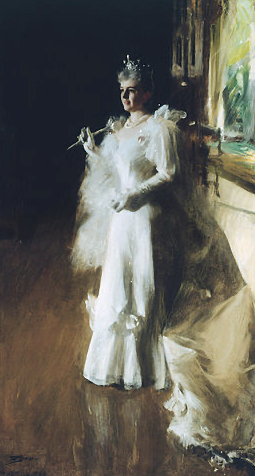
Bertha Matilde Honoré Palmer, Painted by Anders Zorn for the Columbian Worlds Fair.
“There she stands,” Potter Palmer would proudly crow, “with $200,000 dollars on her!”
When I was in eighth grade, studying the Great Chicago Fire of 1871, our assignment was to write an essay on an event or figure from that time. That’s when I stumbled upon Bertha Matilde Honoré Palmer’s name, and I was drawn in by her uniqueness. I began to explore her story, and it has stuck with me ever since. Through her tireless efforts to help rebuild Chicago after the Great Fire , and her role as the city’s “de facto hostess,” Bertha Palmer left an enduring legacy that lives on in Chicago. You can check into the Palmer House and order the brownie she invented. You can walk through the Art Institute and stand in front of Monets she hung in her living room. Bertha had money, yes, but she also had a brain. That is why Bertha Palmer is my role model, she had every reason to do nothing, and she did everything.
Bertha Matilde Honoré, was born on May 22, 1849, in Louisville, Kentucky. When Bertha was six years old, her parents Henry and Eliza moved to Chicago. It was in this home that Potter Palmer, the wealthiest merchant in Chicago, first meet Bertha. She was thirteen at the time and he was thirty-six. Their love story is one of my favorites. Palmer fell “in love at first sight” and decided that he would to wait until she was older to marry her.
Bertha was sent to Georgetown Visitation Preparatory School in Washington, D.C. and also attended St. Xavier Academy. She graduated in 1867 with high academic achievements. Her education, typical for a 19th century elite girl, was not in business, but in training to run a household, manage servants, host events, correspondence and keep accounts. She excelled in French, music, arts, and writing. Skills she later put to good use.
As a wedding gift, Potter Palmer built the Palmer House Hotel, located at State and Quincy. However, just over a year later, the hotel was destroyed in the Great Chicago Fire of 1871. After the fire, Potter Palmer planned to leave Chicago, but Bertha, just twenty-two years old at the time, convinced him to rebuild. She argued that it was “The duty of every Chicagoan is to stay here and rebuild this stricken city.” He took her advice and rebuilt the Palmer House, this time making it fireproof. He then proceeded to buy up State Street property and sell his general store to Marshal Fields and Levi Leiter.
When I ask my friends if they remember Bertha Palmer, my favorite story to tell them is from this time. I always ask,”Do you like eating Brownies?” Then I explained the Palmer House supplied boxed lunches for guests going to the fair and every box needed a dessert. But a slice of pie was messy. Bertha realized they needed something solid and sweet, something that ladies could eat neatly, even wearing gloves. The Palmer House brownie was born.
The Palmers lived on the top floor of the Palmer House for fifteen years. In the mid- 1880s, they moved to “The Castle”, a 42-room mansion on land that was considered a wasteland owned by Potter. Potter Palmer had vision for this area, and today it’s called the Gold Coast of Chicago. An interesting fact about “The Castle”, it was built with no door knobs or locks on any of the exterior doors. The only way you could be admitted was by a servant.
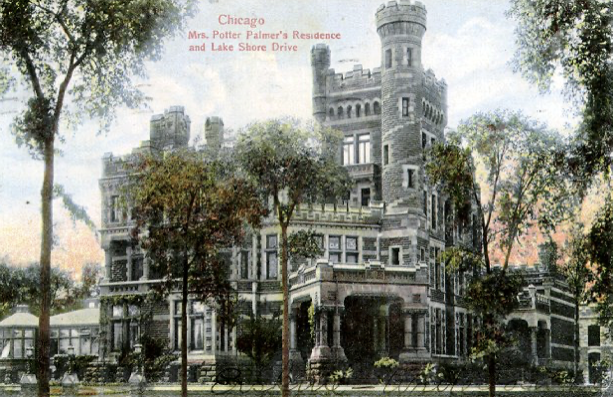
A postcard of the Palmer Mansion in Chicago, IL. Demolished in 1951
Bertha, with all her privilege was not blind to the issues facing women in Chicago. Her approach to philanthropy was quite nuanced. She focused on tangible issues, like providing milk to kindergarteners and meeting with working girls at the castle to learn about their work struggles. Although she addressed various social issues, she didn’t fully support women’s suffrage due to the militant tone of the movement. She believed a woman could be soft-spoken, yet have a strong presence and impact.
About her presence, Bertha was a fashionista, known for her exquisite taste in clothing and jewelry. She’d change clothes multiple times a day, often going to bed without any. Her physical appearance was notable for her hourglass figure, a desirable silhouette during the late 19th century. Her voluptuous bust and wasp waist would have been accentuated by the corsets and dresses she had designed by the House of Worth, in Paris.
Bertha Palmer’s most public role, which made her a household name was serving as the President of the Board of Lady Managers, for the World’s Columbian Exposition in Chicago in 1893. This cemented her reputation as someone who could take charge and get things done. She had very strong options on how she saw the contents and the design of the Woman’s building. Sophia Gregoria Hayden was chosen as the architect, and the two famously clashed. It seems Bertha was a micromanager. At the opening of the Exposition Bertha’s speech was inspiring. She said, “Even more important than the discovery of Columbus, which we are gathered together to celebrate, is the fact that the general government has just discovered woman.” She was pointing out for the fist time woman had been given an official role at a national fair by Congress. Her speech argued that the Woman’s Building wasn’t just about art and crafts. She framed it as proof that women belonged in business, science, government and public life.
In 1900, President McKinley, sent her to Paris as a U.S. Commissioner for their World’s Fair, the Exposition Universelle. It was there she was introduced to Paul Durand-Ruel, the most important dealer of Impressionist art at the time. She was one of the first Americans to champion French Impressionism, and her collection included numerous works by Monet, Renoir, Degas, and Pissarro.
Potter Palmer died in 1902, leaving Bertha the entirety of his eight million dollar estate. He’s often quoted as saying, “She inherited the estate because her next husband would need it.” Yet Bertha never remarried and she doubled his fortune. After a year of mourning, she resumed her lifestyle, buying homes in London and Paris. She lived like European royalty, playing golf with King Edward VII and holding court in her lavish apartments. She hosted private performances, including plays by Oscar Wilde. Chicago only saw her in the winters, where she hosted her annual New Year’s Eve charity ball which was the social event of the season.
In 1910, Bertha Palmer started her last big project by purchasing 350 acres in Sarasota, Florida. She named it; “The Oaks at Osprey Point”. This was her winter home/garden. She eventually owned more than 95,000 acres in what is now Sarasota County. Her cattle ranch, called “Meadow Sweet Pastures” notably, helped save the Chicago cattle business. When she learned the cattle were dying, she imported Brahman cattle from Venezuela, which were resistant to ticks and disease. She didn’t stop at cows, she hired scientists to help her drain the swamps and make land farmable.
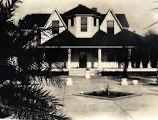
Bertha Palmer’s home “The Oaks” in Sarasota, Florida
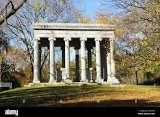
She died May 5th, 1918 at her estate, The Oaks. Breast cancer took her at 68. Her body was brought back to Chicago and she was laid to rest beside Potter Palmer in Graceland Cemetery. This is where the wealthiest families from the Gilded Age were buried. Bertha being an organized woman had designed their tomb 19 years before she died. She commissioned a Greek Revival Pavilion, 16 white marble columns and their sarcophagi side by side. Location is everything even in death. Graceland is designed as a rural cemetery, like a park. Bertha’s pavilion sits right where the path curves and the lake opens up. Architects say it’s “Commanding a view”. She spent her life curating rooms, so of course she curated her final one too.
I have been fascinated with Bertha Matilde Honoré Palmer for over sixty-two years. Even now while writing this blog, I feel a sense of nostalgia. Yes, she was born into wealth. Yes, she married a rich man. But Bertha’s accomplishments were hers. She married Potter Palmer at 21. The city called her “Mrs. Potter Palmer”. By the time she died, Potter was just the guy who used to be married to Bertha.
Much like Maya Angelou, she was firm and confident in her decisions and thoughts. Both of these woman wanted to help society. They had a desire to make a difference. These are qualities I admire.
Next blog: Felisa Rincón de Gautier (Doña Fela), The first female Major of San Juan, Puerto Rico