Finding Myself in Maya Angelou
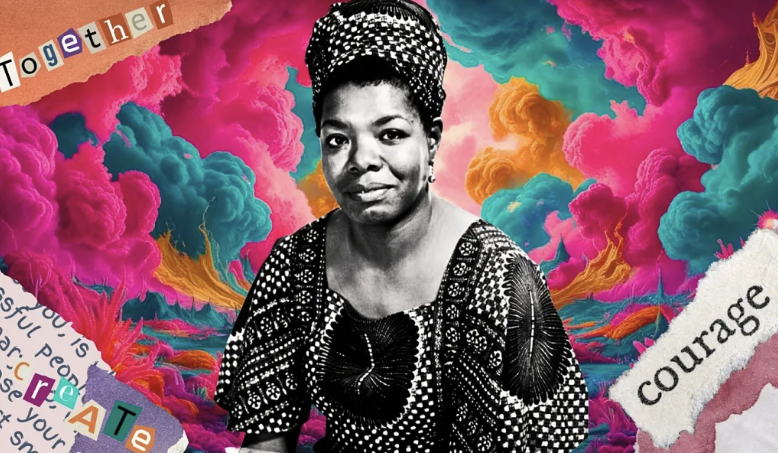
“When someone shows you who they are, believe them the first time.” quote from Maya Angelou
Quit honestly, I thought everyone was familiar with Maya Angelou, but I have learned that isn’t true. When I ask people about her, I constantly hear, “No, who is she?”. Yet for me, her presence looms large. I see her as a woman with an indomitable spirit; on par with Oprah Winfrey, meaning a black woman who rose from nothing to national prominence. Maya Angelou rose from silence and struggle to become a voice for millions. In studying her journey, I am trying to learn how to embrace my own story with honesty and grace.
The first time I learned about Maya Angelou was when I was watching the first inauguration of President Clinton on January 20th, 1993. She read her poem called “On the Pulse of Morning.” The poem called for hope, unity, and renewal. In the poem she named many groups who’ve been marginalized-Black, Native, immigrant, poor, gay, religious, non-religious, saying there’s room for all at the “pulse” of this new day. Her cadence was inseparable from her message. She never rushed; every word held weight, giving me time to absorb her poem. Her calmness conveyed authority. I retained not only her words, but the way she delivered them. In that moment, I found my twentieth century role model. If she could speak and write with that kind of clarity, I wanted to learn how to do it too. So I started looking into her history.
She was born on April 4, 1928, and named Marguerite Annie Johnson. Her parents were Bailey Johnson, a naval dietitian and Vivian Baxter Johnson, who was a nurse. When she was three her parents divorced. She and her brother Bailey went to live with Vivian’s mother, Annie Henderson, who was known as “Momma”. Momma lived in Stamps, Arkansas. There she experienced deep racism and poverty, but her grandmother was stable and very religious. When she was seven Angelou moved to St.Louis with her mother, where her mother’s boyfriend Mr. Freeman, abused her. After she confided to her brother, Freeman was arrested, released and later killed. Believing her voice caused his death, Angelou chose silence for nearly five years. She wrote “I thought my voice killed him; I killed that man because I told his name.”
Her mother brought her back to Stamps, Arkansas. During her mute years she read, wrote poetry and became an observer. Her school teacher Mrs. Bertha Flowers, realized Maya potential and she told her, “It takes the human voice to infuse words with deeper meanings,” She coaxed her back to speech, slowly, Perhaps that slow, clam , measured cadence wasn’t just technique. Maya knew the weight of silence. So when she chose to speak, she made every word matter.
At fourteen, she moved back with her mother to Oakland, California. She dropped out of school at fifteen and worked as a street car conductor. After returning to school she became pregnant and had a son, Guy. She did not marry Guy’s father but she did marry a Greek sailor named Tosh Angelos, whose name she modified to Angelou. This marriage was short lived. Her next move was to Cairo, Egypt with her third husband Vusumzi Make, who was an anti-apartheid activist. There she worked as a journalist, and editor at the Arab Observer. After her divorce from Make, she moved to Ghana, wanting to further explore her heritage. Ghana had a vibrant community of African American expatriates. While living in Ghana she met Malcolm X, who was there on a world tour for the Nation of Islam. She followed him back to the U.S. to work with him on building the Organization of Afro-American Unity. But soon after she arrived Malcolm X was assassinated. Her grief from his loss propelled her to write “I Know Why The Caged Bird Sings.” This book is about her life from the ages of three to sixteen. The book brought her major recognition, becoming popular due to its raw and honest depiction of her childhood trauma, sexual abuse and her feelings of racism.
Her story makes me appreciate how people navigate decades of pain without letting it define them. She didn’t excuse what happened in Stamps, St. Louis, San Francisco, Egypt, or Ghana. She didn’t pretend the abuse, the racism or the silence weren’t real. But she also didn’t stay in that mind set. She wrote, “You may not control all the events that happen to you, but you can decided not to be reduced by them.” I feel she kept reinventing herself to become stronger and more knowledgable about the world around her. Her tool was her voice and the written word.
Her autobiographies, poems and even a cook book cover her life from age three to forty, no fiction, just family and friends. All of her writings cover a period of her life. My blogs are shaped by her structure. I write about my life. My writing and storytelling style is just like hers, very direct. My life has been cloistered compared to Angelou’s. Her grandmother and mother though starkly different women, instilled in her a strong moral compass. She was taught, it seems to me, to claim her freedom and experience life on her own terms. Angelou’s freedom shaped her voice. I was never given that opportunity, and I have always admired women who overcame the obstacles placed in their way. And she had many: rape, mutism, racism, and being a black woman. Yet as one of her poems states: “Still I’ll Rise”. She did. She rose.
I am grateful I heard her speak at President Clinton’s inaugural address. If not for that day, I might never have known her. Reflecting on her life and the way she wrote and spoke, I’ve realized something: I like my writing style. I like the way I put my thoughts down. Truth on the page isn’t easy. Yet Sill, I rise.
My next blog is about another mentor of mine, but from the late 19th century: Bertha Palmer
JANUARY 20, 1993
Maya Angelou Inaugural Poem (1993)
Poet and author Maya Angelou has died. She was 86. In 1993, she was invited by then-President-Elect Bill Clinton to deliver the Inaugural poem. Here she is reciting her poem, "On the Pulse of Morning," on January 20, 1993.