The Dark Horse U.S. President
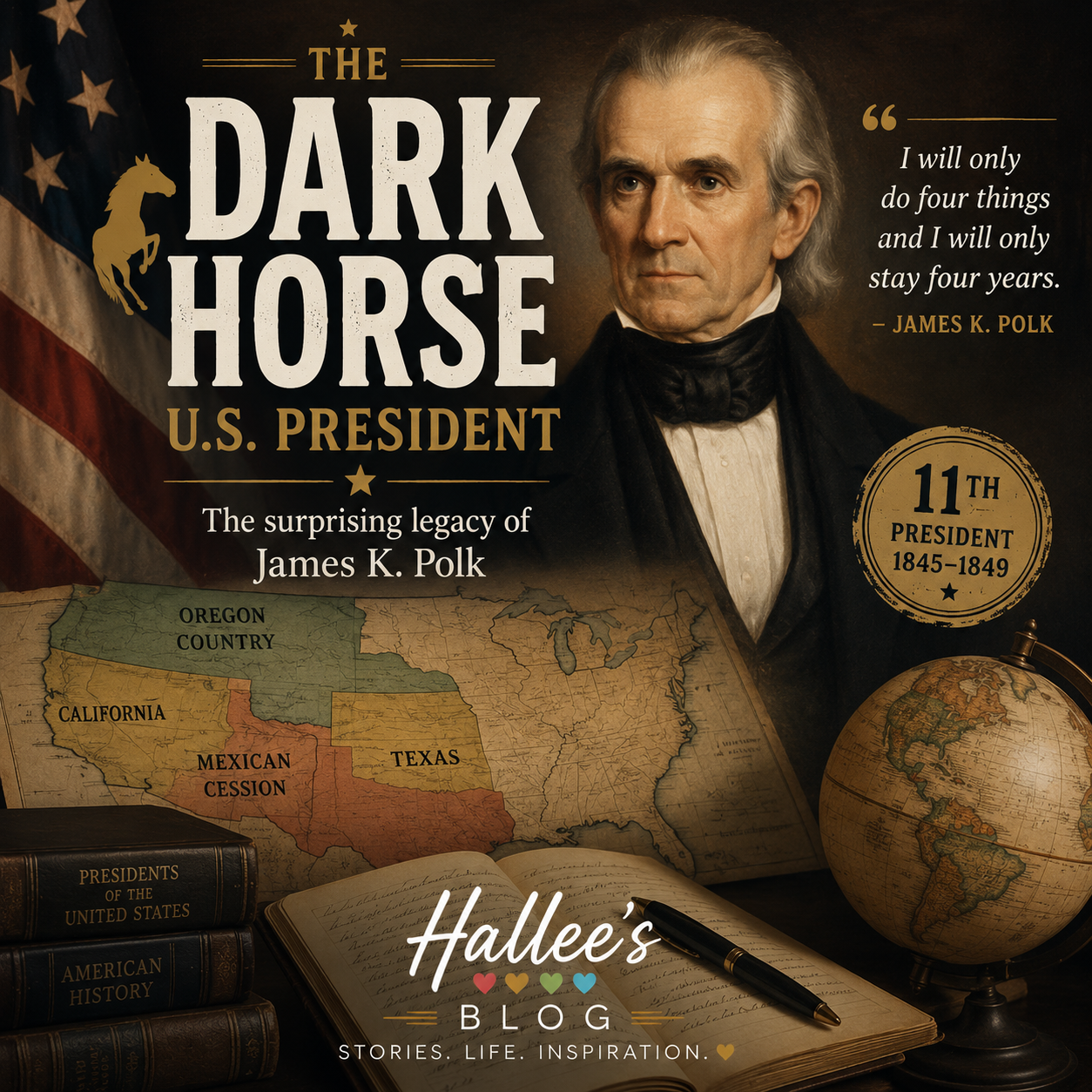
“I will only do four things and I will only stay four years.” quote from President James K. Polk
In today’s world we are constantly bombarded with stories about our current President and the politics of the moment. Over my lifetime, I have lived through thirteen U.S. Presidents. Thirteen very different men who led our country through very different moments in American history. I have witnessed countless changes in our nation and have memories and opinions about each of these presidents. But if you asked me to choose my favorite, you might be surprised by my answer: James K. Polk the eleventh US President.
My fascination with U.S. Presidents began with the election of Ronald Reagan in 1980. At the time, I knew him mainly as an actor. My eight year old son, on the other hand, was more interested in how his hair looked! Reagan’s election sparked something in me. I became curious about the presidents who came before him, why we chose them, what they accomplished and what made each of them important in the story of our country.
My curiosity led me to start collecting books and researching the 39 presidents who came before Ronald Reagan. The more I read, the more fascinated I became with the people behind the names, the decisions they made, the challenges they faced in the times they lived. I also learned history books do not always tell the complete story. Every president leaves behind a complicated legacy, and sometimes it takes generations for the full consequences of their decisions to become clear.
Polk became my favorite because of the enormous impact his presidency had on the expansion of United States. Born in North Carolina in 1795, James Polk moved with his family toTennessee when he was around ten. His family was of Scottish-Irish descent. Both his grandfathers had fought in the Revolutionary War. His father, Samuel Polk, was a prosperous landowner who owned thousands of acres and more than fifty enslaved people. James Polk, also became a slaveholder.
Polk had served as Speaker of the House and Governor of Tennessee, giving him a respected reputation within the Democratic Party. He did not attend the Democratic Convention in 1844, but he was hardly an unknown. Still, few expected him to emerge as the party’s presidential nominee. The convention in Baltimore was deadlocked, with delegates voting seven times but unable to choose between former President Martin Van Buren and Lewis Cass. Then, on the eighth ballot, someone said, “What about Polk? ” The South liked him because he wanted Texas. The North liked him because he wanted Oregon. On the ninth ballot they unanimously nominated Polk for president.
Newspapers quickly began calling him a “dark horse,” a term that has since become part of our political vocabulary. The image is of a horse that no one expects to win because no one has been paying attention to it, until it crosses the finish line first.
His campaign slogan was, “I will only do four things and I will only stay four years.” And he kept his promise. The four things were
Cut existing tariffs by passing the Walker Tariff of 1846.
Brought back the Independent Treasury, separating the government’s money from private banks. Congress passed it in 1846
Settled the Oregon question with Britain. The campaign was “54 40 or fight.” Britain and the U.S. compromised at the 49th parallel in 1846, which defined the boundary between the U.S. and Canada.
The Mexican-American War brought about the Treaty of Guadalupe Hidalgo in 1848. The United States acquired California , Texas and New Mexico .
But after Polk got what he wanted geographically, he couldn’t control what happened politically afterward. Once these vast new territories became part of the U.S., Americans began fighting over whether slavery would be allowed to spread into them. The debate became one of the greatest political crises the country had ever faced and a problem that would dominate the presidency that followed.
Polk’s legacy is therefore complicated. His vision helped shape the map of the United States, while the consequences of that expansion contributed to some of the deepest conflicts in American history.
So why, you may ask, is he my favorite? I see Polk as a man of his time, with a very clear vision of what he wanted the United States to become. Polk believed in Manifest Destiny, wanting America to stretch “from sea to shining sea.” He was ruthless about it, but he didn’t work alone. Congress was behind him the whole way. Thomas Jefferson is heralded as the great expansionist, for buying the Louisiana Purchase for $15 million . Yet, Polk’s Mexican Cession cost the same $15 million, and he got more land for the money. And I wonder what the map of the US would like today if it were not for Polk’s vision.
Now that you know a little of James K. Polk’s history, who would you say is your favorite President?