The Curious Story About the Creation of: The State of Oklahoma
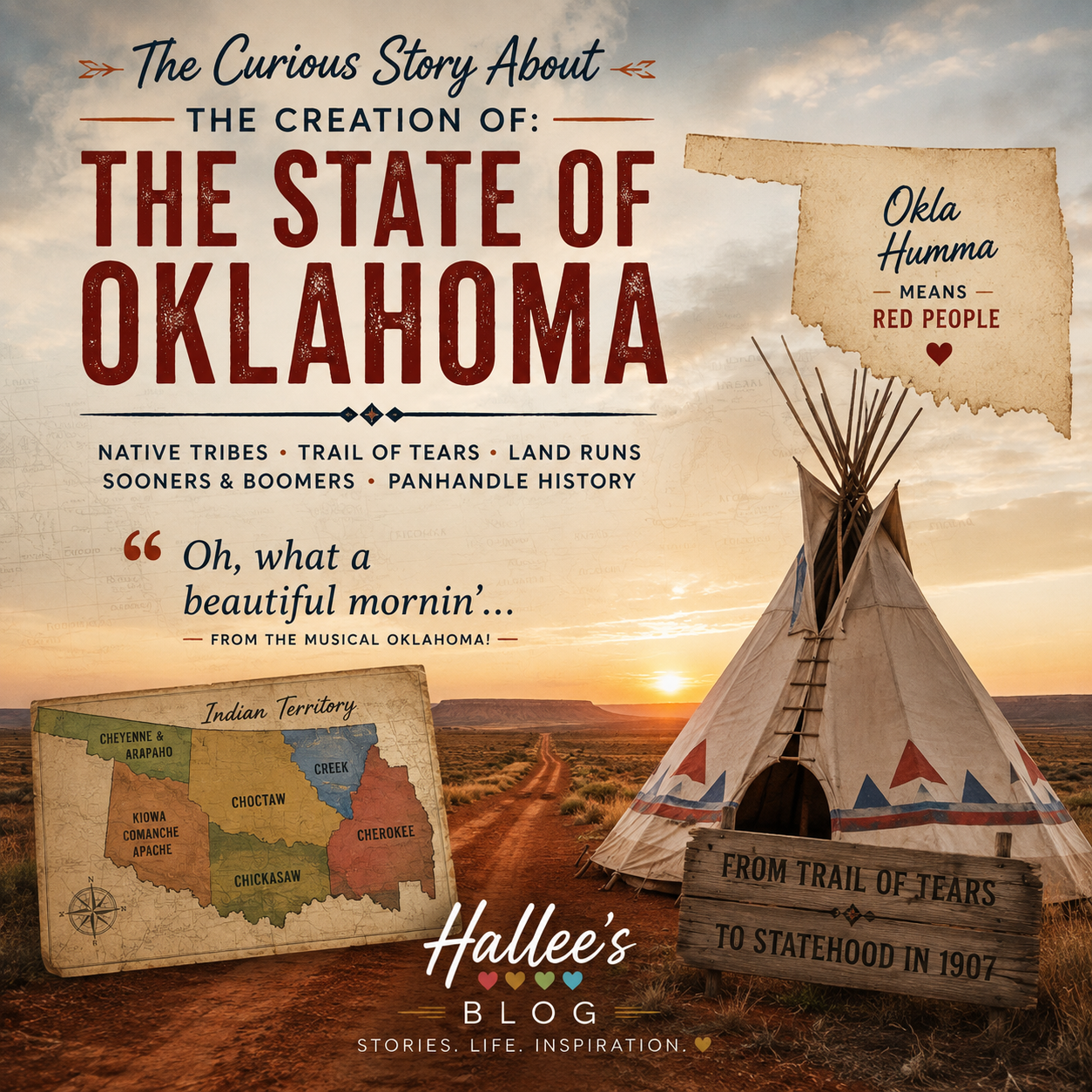
“Oh, what a beautiful mornin’, Oh, what a beautiful day! I got a beautiful feelin’ Everythings’s goin my way.” From the musical Oklahoma.
However, for the five civilized tribes; Cherokee, Creek, Choctaw, Chickasaw and Seminole, this song would never be in their repertoire. These tribes lived on 25 million acres of land which is now Georgia, Tennessee, Alabama, Florida, Mississippi and North Carolina. It took around 28 years for these displaced individuals to be forced to march out of their homeland west in an event called by the Indian Tribes the “Trail of. Tears.” However, the US called it The Indian Removal Act, passed by Congress and signed into law by President Andrew Jackson.
I lived in Oklahoma for eight years and never learned to enjoy my time there. I always wondered why the dirt was red. Perhaps it was from the blood of the Indians and the buffalo? I noticed the cars were different, mostly trucks with gun racks in the back windows holding hunting rifles . The men wore cowboy hats, jeans and boots, even though they were not cowboys. The way the people spoke was strange to me too. The phrase “y all” was peppered into every conversation along with “God bless his soul”. On television, the Sunday programs featured different religious leaders, Christian, Protestant, Baptist, Evangelist, Holy Rollers, never Jewish or Catholic. And then there were commercials for gun shows! Donuts shops were everywhere. Such a different world from my hometown of Chicago.
Chicago’s name came from the Miami Indian Tribe. The name means wild onion, wild garlic or stripped skunk. Oklahoma is a Choctaw word that means “Red People”. “Okla” means people and “Humma.” means red. All over the U.S. map there are 27 city names that come from the Native languages. In the early 1800s, Oklahoma was called “Indian Territory.” Then in the 1890s until statehood in 1907, it was referred to as the “Twin Territories.” Indian Territory was the eastern half and Oklahoma and the Panhandle the western half.
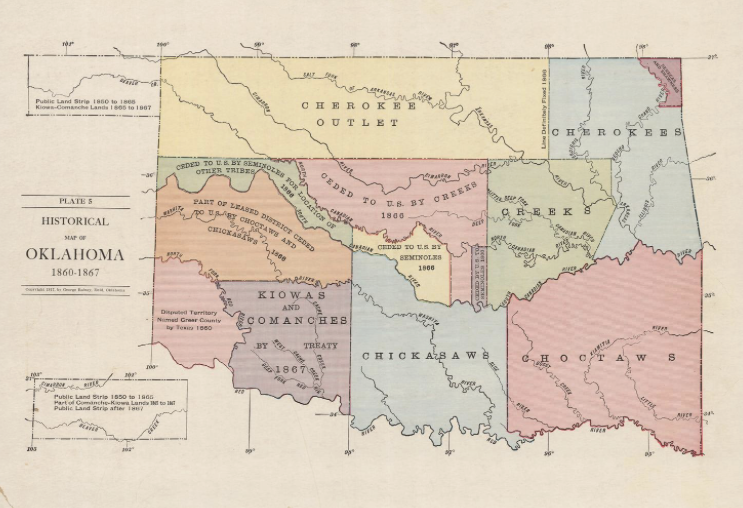
When President Thomas Jefferson purchased land from France in 1803 as part of the Louisiana Purchase, the U.S. government eventually used that vast new territory to relocated the more than 39 Native tribes to what would be called IndianTerritory. I found this old map of Oklahoma. You can see how the different tribes were given sections of the land. Curious, that the center rectangle of Oklahoma was not allotted to the tribes. Because of this center gap the government opened the land to settlement creating “land runs” Some settlers started to move in sooner than the date of the run and they were called “Sooners”. Others abided by the law in a different land run in the center of the state around Oklahoma City and were called “Boomers.” There were seven “land runs” in Oklahoma. Aside: I went to the University of Oklahoma. “Boomer Sooner” was the fight song played at all the athletic games I attended.
Boomer Sooner, Boomer Sooner, Boomer Sooner, Boomer Sooner, OKU
I’m Sooner born and Sooner bred and when I die, I’ll be Sooner Dead
Rah Oklahoma, Rah Oklahoma, Rah Oklahoma, OKU! HURRAYHHHHH
When the crowd sang this song, I at least, had no idea of the hardships the frontier people and the Indians faced. It was just a catchy tune. Getting back to the story:
The ninth President, William Henry Harrison, signed the proclamation that led to the Oklahoma Land Rush of 1889. The concept of “Manifest Destiny” sent settlers to rush to this center area, surrounded by Indian land, to obtain 160 acres of their own. This proclamation was called “The Homestead Act”. Then came the Curtis Act of 1898 which dissolved tribal governments.
While this was occurring, the tribes got together and realized that if they didn’t assimilate their land it would be taken from them. In 1905, The Five Civilized Tribes, wrote a constitution for their land to be called The State of Sequoyah, after the Cherokee scholar who created the Cherokee alphabet. At the Sequoyah Convention of 1905, they wrote their constitution, asking to have their land be admitted as a state. But their constitution was not acknowledged by the U.S. Congress due to party politics. President Theodore Roosevelt, in 1906 signed the Oklahoma Enabling Act, which opposed the constitution of Sequoyah then giving it over to the settlers who used the Indian’s constitution with very few changes. In 1907, the Indian and Oklahoma territories joined together to become the 46th state. Interesting note, in the U.S. Capital in Washington D.C. each state has two statues of their prominent historical figures. Oklahoma is represented by Sequoyah and Will Rogers.
WHAT ABOUT THE PAN HANDLE?
The Missouri Compromise of 1850, prohibited slavery north of Mason Dixon Line. Texas, was admitted as a slave state. But they had to give up land and change it’s borders if they wanted to join the union. Texas had to relinquish a 170-mile strip of land called the “Public Land Strip” or more commonly referred to as “No Man’s Land” or the “Badlands”. It was also called Robber’s Roost because there was no government. The outlaws at the time could rob banks, steal cattle and flee across the border where no law enforcement existed. It was the “Wild West.” We can also think of the book, “The Grapes of Wreath,” about the dust bowl which hit this area in the 1930s. The Panhandle is the only area located with four states on its borders: Colorado, Kansas, Texas, and New Mexico. The Panhandle became part of Oklahoma in 1890 with the Organic Act.
Oklahoma was bought, divided, rushed into and dusted over. President Jefferson purchased it without seeing it as part of the Louisiana Purchase in 1803. President Jackson signed the Indian Removal Act that led to the “Trail of Tears” in the 1830s, sending the Five Tribes to what would become Indian Territory. In Bartlesville the first commercial oil well in 1897 started the boom that brought people rushing in and pushed more native people out. President Harrison started the land rush “ie” Boomer Sooner, in 1889, and President Theodore. Roosevelt made it a state in 1907.
Now that we live in San Juan, Puerto Rico, you’d think we’d meet people from my hometown, Chicago. But No. We kept meeting people from Tulsa, which is where my husband was born. And when reading about actors, musicians, movie stars so many are from Tulsa, or Oklahoma City, the capital. The author Steinbeck called them Okies because they appeared every where. These Okies are scattered into the wind, like the Dust Bowl.