How a Poem Written in War Became our National Anthem
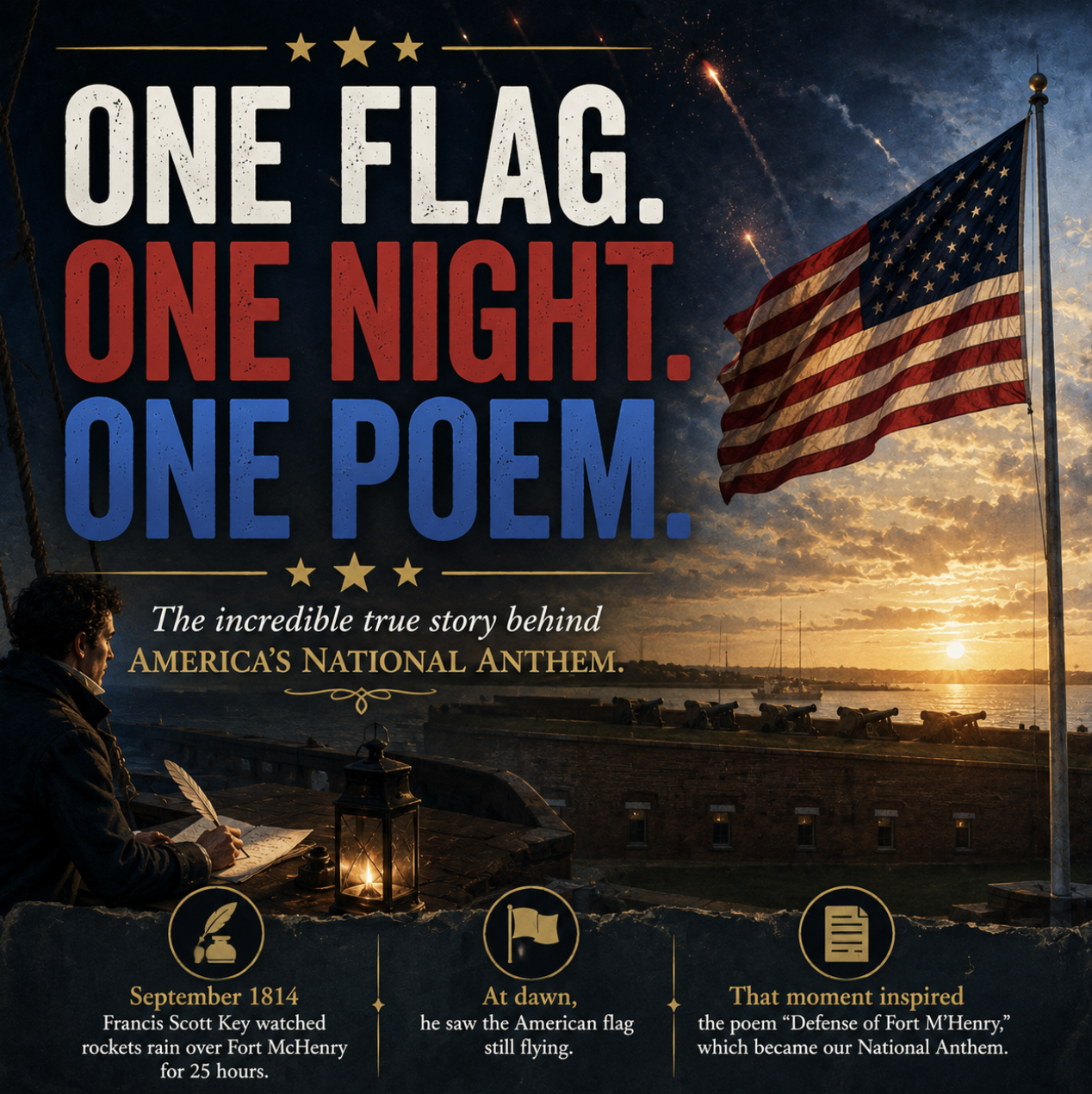
In August, 1814, British troops marched into Washington DC and sat down to a dinner still warm on the White House dining room table. In September 1814, a lawyer trapped on an enemy ship watched rockets rain over Fort McHenry for 25 hours straight. Though the War of 1812 lasted only two and a half years from June 18, 1812 to February 18, 1815, it produced two defining American stories within weeks of each other.
First: In August 1814, as British troops marched on Washington, First Lady Dolly Madison, was preparing a dinner party for 40. With just hours to spare, she had the presence of mind to save the Gilbert Stuart’s portrait of George Washington, the White House silver, key documents and the red velvet curtains. The British arrived, ate the meal, drank her wine, and enjoyed her favorite desert oyster ice cream. Then the British set the mansion ablaze. That act of composure under fire is why Dolly Madison is still remembered as one of America’s most iconic First Ladies. She wasn’t just a hostess, she has become a symbol of grace and grit in crisis.
Second: Three weeks later on September 13-14, 1814, forty miles away in Baltimore Harbor, Francis Scott Key was approached by his friend Colonel John Stuart Skinner. Skinner, the U.S. agent for prisoner exchange, asked Key to help negotiate the release of 65 year old Dr. William Beanes. Dr. Beanes had been arrested after the British raided his town. The doctor had helped jail some British stragglers who were looting homes. In retaliation, the British arrested him and brought him to their warship the HMS Tonnant.
Under a flag of truce, Key and Skinner sailed out and successfully secured Dr. Beanes’s release. However, the British would not let them go back to land. They were detained aboard their own truce vessel. The British didn’t want them warning General George Armistead about the impending bombardment of Fort McHenry. From the ship, Key witnessed the 25 hour attack. At dawn, he saw the massive 30 by 42 foot garrison flag still flying over the fort, which was proof the Americans had held. Moved, he pulled from his vest an envelope and started writing “Defense of Fort M’Henry”, the poem that would later become “The Star Spangled Banner”.
The poem didn’t become a song right away. Key gave it to his brother in law, Judge Joseph H. Nicholson, who recognized that the words fit the melody of a popular drinking song; “To Anacreon in Heaven.” That tune was the official song of the Anacreontic Society, a London gentlemen’s music club. The lyrics celebrate the Ancient Greek poet, Anacreon, who was known for his love of wine and music. The Judge had the poem printed with a note that it should be sung to this tune, and by October of 1814 the named changed to “The Star Spangled Banner.”
Before the national anthem became the Star Spangled Banner the United States didn’t have an official anthem. Songs like “Hail, Columbia” and “My Country Tis of Thee,” were used at patriotic events and government functions. But Key’s poem, set to “To Anacreon in Heaven” caught on. By 1931 Congress made it official.
The adoption of both the anthem and the flag cemented two symbols that still define public moments of unity. When the anthem is played, people stand, face the flag and place their hands over their hearts. We have been taught that these symbols mean survival, shared identity, and a collective memory of our ancestors who worked to preserve our way of life. In America, it started in 1814, with a portrait saved from fire and a flag that survived the night.